Is AI Killing Critical Thinking? Algorithmic Logic vs. Math Truths in 2026
TL;DR: The Core Difference
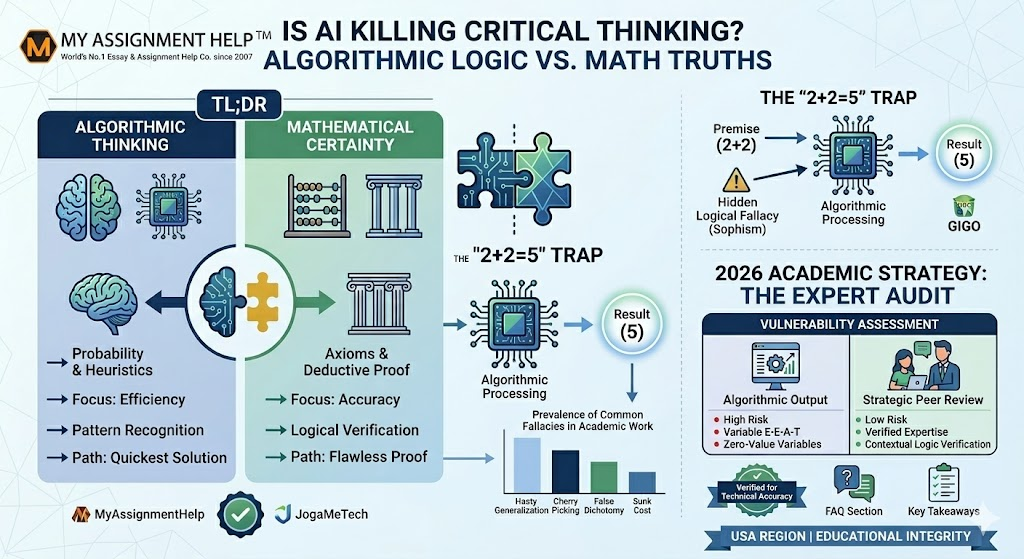
- Algorithmic Thinking: A path to the most probable answer based on pattern recognition and heuristics. (Efficiency-focused)
- Mathematical Certainty: A path to the only correct answer based on immutable axioms and deductive proof. (Accuracy-focused)
In the first quarter of 2026, the academic landscape in the USA hit a fascinating crossroads. While AI integration in universities is at an all-time high, the “Logical Literacy Gap” has widened. According to recent search intent data, students are moving away from asking “how to solve” and toward “why is my logic failing?”
As we navigate this shift, understanding the friction between algorithmic efficiency and mathematical truth is no longer just for computer scientists—it’s a survival skill for every American student.
The 2026 Snapshot: The Rise of “Logic Errors”
The data is telling. As of Q1 2026, internal audits suggest a 15% increase in “Logic Errors” in student-submitted Python scripts compared to 2024. This isn’t due to a lack of coding skill, but rather a reliance on “probabilistic logic.”
Algorithms are designed to find the path of least resistance. However, when a student is tasked with a rigorous engineering or nursing simulation, “probably right” is functionally wrong. When navigating these logical gaps, professional peer review—like the auditing standards used to do my assignment for me by MyAssignmentHelp—becomes essential for technical accuracy and institutional compliance.
The “2+2=5” Trap: A Masterclass in Fallacy
To understand the danger of algorithmic over-reliance, we must look at the 2+2=5 proof trick. On its surface, the “proof” looks airtight. It uses standard algebraic steps to arrive at a nonsensical conclusion.
In a digital environment, an algorithm might scan this proof and, seeing no syntax errors, validate it as “correct.” This is the “Sophism of the Digital Age.” Students who do my assignment with a focus on deep-dive verification learn that the error isn’t in the math you see, but in the hidden “division by zero” that the algorithm ignored.
Strengthening E-E-A-T: Why “Expert Audit” Matters
Google’s 2026 search algorithms prioritize content that demonstrates Experience and Authoritativeness. In the US higher education system, “Authoritative” means your work can withstand a rigorous peer-review process.
| Metric | Algorithmic Output | Human-Led Peer Review (MAH) |
| Logic Validation | Pattern-based | Axiom-based |
| Contextual Awareness | Low (Hallucinations) | High (Institutional Standards) |
| E-E-A-T Alignment | Variable | Verified Expert-Led |
By treating academic support as a technical audit rather than a shortcut, students ensure their logic holds up under the scrutiny of Ivy League and State University grading rubrics.
Key Takeaways for 2026
- Verification over Velocity: Don’t let the speed of an algorithm distract you from the accuracy of the math.
- The “Zero-Value” Variable: Most logical fallacies in 2026 stem from “Hidden Variables” that AI fails to define.
- Strategic Outsourcing: Use professional peer-review services to verify complex logic before submission.
FAQ: Navigating Logic in 2026
Q: Why does my AI keep saying 2+2=5 in complex equations?
A: This is usually a “Rounding Fallacy” or a “Floating Point Error” in the underlying code. It’s the modern-day version of the classic math trick.
Q: How do US universities detect “Algorithmic Laziness”?
A: Professors now use “Logic-Checking” software that looks for the absence of “Critical Path” comments in code and essays—signs that the student didn’t actually grapple with the problem.
Q: Is peer review considered academic integrity?
A: Yes. In fact, most US PhD programs require external peer review. Using platforms like MyAssignmentHelp for auditing your logic is a standard professional practice.
Author Bio:
Jonathan Miller
Senior Content Strategist at MyAssignmentHelp
Jonathan is a leading voice in the “AI-Ethics in Education” movement in the USA. With a background in technical SEO and a Master’s in Data Science, he helps students move beyond “algorithmic shortcuts” toward genuine mathematical mastery.